
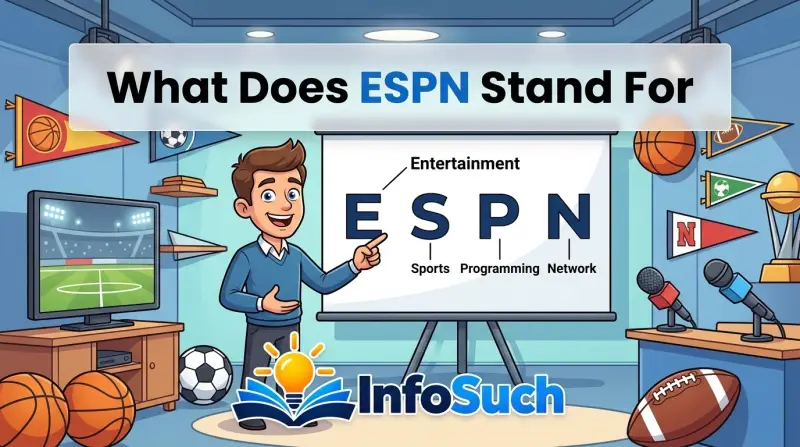
If you've ever asked what does espn stand for, you're not the first. The simple answer is Entertainment and Sports Programming Network. But the full story has a twist.
As of 2026, ESPN is legally ESPN, Inc. The Walt Disney Company owns 80%, and Hearst Communications owns 20%. That shift matters more than most people realize.
Let's walk through it.
Quick Answer: What Does ESPN Stand For?
ESPN originally stood for Entertainment and Sports Programming Network. That phrase was the network's legal name at launch on September 7, 1979. Today, the company is officially ESPN, Inc.
The full name is history, not current branding.
The Original Name: Entertainment and Sports Programming Network
The original name described the business exactly. Sports around the clock, with entertainment coverage mixed in. That idea was a gamble in 1979.
Bill and Scott Rasmussen created the network. They worked out of Bristol, Connecticut, which is still ESPN's headquarters today. Cable operators and advertisers needed a clear name, so the long phrase made sense.
The first broadcast came from that same Connecticut town. The full corporate name lived on in legal documents for years, even after the on-air brand shortened to ESPN.
| Fact | Detail |
|---|---|
| Original full name | Entertainment and Sports Programming Network |
| Launch date | September 7, 1979 |
| Founders | Bill and Scott Rasmussen |
| Headquarters | Bristol, Connecticut |
| Original mission | Live sports around the clock |
Two Answers, One Brand: Original Meaning vs. Current Official Status
Here's the thing. "What does ESPN stand for?" has two correct answers. The first is historical.
The second is current.
| Context | What ESPN stands for |
|---|---|
| Historical / original | Entertainment and Sports Programming Network |
| Current corporate / legal | ESPN, Inc., with no full expansion |
| Cultural / everyday | The brand itself |
If you're talking about the founding days, use the full name. If you're talking about the company today, use ESPN. Neither answer is wrong.
They just belong to different eras.
The company legally dropped the full phrase years ago. That's why quick answers often feel incomplete. They give you the original name, then stop.
But the brand itself has moved on.
Why ESPN Stopped Using Its Full Name
The full name stopped matching the business. ESPN expanded beyond a single network. As of 2026, it includes ESPN+, websites, radio, and original documentaries.
The abbreviation was always the everyday name. Fans said ESPN. TV guides said ESPN.
On-air talent said ESPN. The long phrase only appeared in formal settings.
So the company leaned into the shorthand. The legal shift happened as ESPN grew into a media family. ESPN, Inc. became the umbrella entity, and the original name faded from official use.
This is a common pattern. CNN did the same thing. A&E did too.
So did BMW and Kentucky Fried Chicken. The initials become so familiar that the full name becomes trivia.
Who Owns ESPN and Does It Matter Here?
Ownership explains the corporate structure. The Walt Disney Company owns 80% of ESPN. Hearst Communications owns the remaining 20%.
Disney acquired its controlling stake in the 1990s.
You can verify this in primary sources. The Walt Disney Company lists ESPN as a major brand in its corporate reporting. Hearst Communications confirms its 20% stake on its own corporate site.
Both are official sources, not third-party summaries. That makes the ownership picture easy to confirm.
| Owner | Share |
|---|---|
| The Walt Disney Company | 80% |
| Hearst Communications | 20% |
Does this change the answer to "what does ESPN stand for"? Not really. It just explains why the company operates as ESPN, Inc. rather than under its original full name.
When to Use the Full Name vs. Just "ESPN"
Context decides which answer is correct. The full name belongs to history. ESPN belongs to everything after that.
In Everyday Conversation
Nobody says "Entertainment and Sports Programming Network" in casual chat. You'd sound like a history textbook. When you're talking about a game with friends, the answer is just ESPN.
The full name only comes up as trivia.
In Professional Writing and Journalism
Precision matters here. If you're writing about the network's 1979 launch, spell out the original name once. Then use ESPN for the rest of the piece.
This is the standard approach in media reporting.
| Situation | What to say |
|---|---|
| Casual conversation | ESPN |
| Historical article about 1979 | Entertainment and Sports Programming Network (then ESPN) |
| Current news article | ESPN |
| Legal or corporate document | ESPN, Inc. |
| Trivia conversation | Both answers, with context |
In Business or Legal Contexts
Legal documents use the exact registered name: ESPN, Inc. Contracts, licensing agreements, and corporate filings all reference the company this way. The original full name rarely appears in modern paperwork.
Common Mistakes People Make When Explaining ESPN
The biggest mistake is treating the original name as the current legal name. The full name was retired from official use. ESPN, Inc. is the entity that signs contracts today.
Another mistake is inventing alternate expansions. Popular rumors have floated other meanings over the years. None of them are accurate.
People also confuse early investors with founders. Getty Oil and Anheuser-Busch invested early, but they didn't create the network. Bill and Scott Rasmussen did.
| Mistake | Why it's wrong |
|---|---|
| Saying the full name is current | The company is legally ESPN, Inc. |
| Inventing alternate expansions | The original meaning is well documented |
| Crediting Getty Oil as founder | They were an early investor, not a founder |
| Using the full name in modern writing | It sounds dated and inaccurate |
| Ignoring the historical context | The full name is still valid for pre-1980s references |
How to Verify Sports Media Facts Like a Pro
You don't need to guess when checking facts about ESPN. The ESPN Press Room provides official statements about branding and operations.
For ownership, go straight to corporate filings. The Walt Disney Company's investor materials list ESPN as a major segment. Hearst Communications confirms the same on its website.
Old newspaper archives from September 1979 will show the original name in action. University libraries and the Library of Congress often hold those records.
- Check the ESPN Press Room for current branding.
- Review Disney's annual report for ownership details.
- Search newspaper archives from September 1979 for the launch.
- Confirm the legal entity name through corporate filings.
- Cross-reference two independent primary sources.
This method works for nearly any media brand question. Go to the company or the regulator. Skip the third-party recap sites that recycle old errors.
Why This Distinction Actually Matters
You might wonder if this is just pedantic. It's not. The distinction matters for three practical reasons.
First, accuracy builds trust. If you're writing, teaching, or producing content, a small factual error undercuts your credibility. Someone who knows ESPN's history will catch the mistake.
Second, legal and business contexts require precision. Contracts use official registered names. ESPN, Inc. is the entity that signs agreements.
Using the wrong name can create confusion.
Third, the evolution of the name tells a bigger story about media. ESPN's shift from a descriptive full name to a standalone brand mirrors what happened with CNN, A&E, and Kentucky Fried Chicken.
The brand is strong enough to stand alone. That's the real lesson. ESPN no longer needs to explain what the letters mean, because the letters themselves became the meaning.
Final Decision Guide: What to Say and When
If someone asks you what ESPN stands for, lead with the original name. Then add the current status. That gives the complete, accurate answer in one breath.
Say this: "ESPN originally stood for Entertainment and Sports Programming Network. Today, the company is officially ESPN, Inc."
That response works in every context. Trivia night. A school assignment.
A corporate memo. You're covered.
Remember the key points:
- The original name was Entertainment and Sports Programming Network.
- The current legal name is ESPN, Inc.
- Disney owns 80%, Hearst owns 20%.
- Use the full name only for historical references.
- Use ESPN for anything modern.
That's the whole story. One brand, two names, and a clear rule for when to use each.