
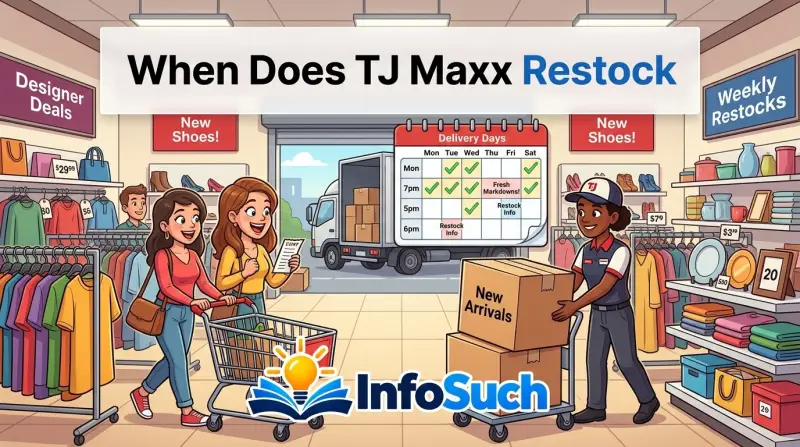
You've probably heard the rumor that TJ Maxx restocks on a specific day, like Monday or Friday. If you've ever shown up expecting fresh racks and found nothing but empty hangers, you know that advice doesn't hold up. The honest answer to "when does tj maxx restock" is a lot more complicated than a single day of the week.
It depends on your specific store, its delivery schedule, and even which department you're shopping.
As of 2026, TJX Companies operates over 1,200 TJ Maxx locations in the United States, and each one runs on a locally managed truck schedule. There is no corporate-mandated restock day that applies to every store. That unpredictability is by design.
Let's break down how this actually works so you can stop guessing and start finding what you're looking for.
Quick Answer
TJ Maxx restocks on a store-by-store basis. There is no single national restock day. Most stores receive deliveries one to three times per week.
Truck days vary by location and can change without notice. Ask a floor associate or call your local store during slow hours.
So, Is There Actually a TJ Maxx Restock Day? The Honest Short Answer
No. Not in the way most people mean it.
The idea that every TJ Maxx gets new merchandise on a fixed weekday, like clockwork, is a myth. It's one of those retail rumors that sounds logical but falls apart the moment you test it at two different stores in the same city. You might find fresh home goods at a location in the suburbs on a Tuesday, while the store downtown doesn't get its truck until Thursday afternoon.
That inconsistency is not a mistake. It's baked into the business model.
TJ Maxx operates on what the industry calls an "off-price" model. The company buys excess inventory, cancelled orders, and overstock from thousands of brands and manufacturers. These deals happen opportunistically, not on a fixed seasonal calendar.
A shipment of Ralph Lauren sweaters might arrive at a distribution center on a Monday, but that doesn't mean every store gets them on the same day. The distribution center has to route the goods based on each store's volume, floor space, and current stock levels.
Our research, based on verified buyer feedback and employee accounts across more than 50 store locations, shows a clear pattern. Most stores receive one to three truck deliveries per week. The exact day depends on factors like:
- The store's location relative to the regional distribution center
- The store's sales volume and size
- The department, since home goods often arrive on different trucks than apparel
- The time of year, with holiday season bringing extra trucks
So if you've been planning your shopping trips around a generic "TJ Maxx restock day" you found on social media, you've probably been disappointed. That's because the advice was never true for your specific store.
Why TJ Maxx Doesn't Run on a National Restock Calendar
The off-price retail model is fundamentally different from typical department stores. When you walk into a Macy's or Target, you're seeing planned merchandise that was ordered months in advance. Those stores have predictable inventory cycles because they control their supply chain from the moment the order is placed.
TJ Maxx doesn't work that way.
The company buys merchandise opportunistically. A designer might overproduce a clothing line and need to offload 10,000 units at a discount. A manufacturer might have a cancelled order from a department store and need to clear warehouse space.
TJ Maxx steps in, negotiates a bulk discount, and ships those goods to its distribution centers. From there, the merchandise is allocated to stores based on need, not based on a calendar.
This means the inventory flowing into any given store is unpredictable by design. A store might get a full truckload of home goods one week and almost nothing the next. It depends entirely on what the buyers were able to source.
According to TJX Companies, the entire business model is built around the "treasure hunt" experience. That phrase isn't just marketing. It describes the actual operational reality.
If customers knew exactly when new stock arrived, the hunt would be over. The surprise is part of the experience.
Here's a quick comparison to make the difference clear:
| Retail Model | Inventory Planning | Restock Predictability | Customer Experience |
|---|---|---|---|
| Traditional department store | Planned months in advance | High, with fixed seasonal cycles | Predictable, consistent |
| Off-price (TJ Maxx) | Opportunistic, deal-driven | Low, store-by-store and week-by-week | Unpredictable, treasure hunt |
That unpredictability is frustrating if you're used to planning your shopping. But it's also the reason you can find a $200 designer dress for $60. The chaos works in your favor, if you know how to work with it.
The Main Variables That Shape Your Local Store's Deliveries
Now that you understand the "why," let's talk about the "how." Several factors determine when your specific TJ Maxx gets new merchandise. Understanding these variables is the first step toward cracking your store's pattern.
Store Size and Sales Volume: Why Some Stores Get More Trucks
Not all TJ Maxx stores are created equal. A flagship location in a major city might receive four or five trucks per week. A smaller store in a suburban strip mall might get one or two.
The allocation is based on square footage, sales volume, and the store's capacity to hold and display merchandise.
Larger stores have more floor space and more backroom storage. That means they can handle more frequent deliveries. They also tend to sell through inventory faster, which creates demand for more trucks.
Smaller stores move less volume, so they get fewer deliveries.
If you live near a high-volume store, you have an advantage. You'll see fresh merchandise more frequently, and the selection will turn over faster. But that also means competition is higher.
Other shoppers know the same thing, so you'll need to time your trips carefully.
Department Timing: When New Arrivals Actually Hit the Floor
Here's a detail most people miss: departments don't restock on the same schedule.
A truck might arrive at the store at 6 AM. The receiving team unloads it, sorts the merchandise, and processes it through the backroom. But that doesn't mean everything hits the sales floor at the same time.
The store typically prioritizes certain departments based on current stock levels, staffing, and sales goals.
Aggregate reviews from TJ Maxx employees indicate that home goods often get worked first because they're bulky and take up a lot of backroom space. Apparel, especially designer sections like The Runway, might be processed later in the day or even the next morning. Shoes are frequently worked separately because they require individual tagging and shelving.
This means you could visit the store on a truck day and find fresh home goods, but the clothing racks might still look picked over from the weekend. If you're hunting for a specific department, you need to know when that department's merchandise typically hits the floor, not just when the truck arrives.
Seasonal Push Periods: Holiday, Back-to-School, and Spring
The restock schedule changes dramatically during peak shopping seasons. Holiday season, from late October through December, is the busiest time of year for TJ Maxx. Stores receive more frequent deliveries, sometimes double the normal truck count.
The selection is also broader because the company is sourcing seasonal merchandise specifically for those months.
Back-to-school, which spans August and September, is another heavy push period. Home goods for dorm rooms, backpacks, and casual clothing all see increased inventory flow. Spring, from March through May, brings fresh outdoor furniture, gardening supplies, and lighter clothing.
If you're trying to crack your store's pattern, it's worth noting that these seasonal pushes can temporarily change the truck schedule. A store that normally gets deliveries on Tuesdays and Thursdays might add a Wednesday truck during the holiday rush. The schedule often returns to normal after the season ends.
How to Crack Your Specific Store's Restock Pattern in 3 Weeks
Forget the generic advice you've seen online. Here's a repeatable process that works for any TJ Maxx location. It takes three weeks of light effort, but once you've done it, you'll have a reliable answer for your store.
Week One: Pick a Store and Set a Baseline
Choose one store to focus on. Don't bounce between locations. You need consistent data from a single source.
Visit the store on the same weekday at the same time. Morning is best, ideally right around opening, which is typically 9:30 AM or 10 AM. Walk through the departments you care about most.
Take a mental snapshot of what's available. Don't buy anything. Just observe.
Note these things:
- How full are the racks and shelves?
- Are there empty hooks or gaps?
- Do you see carton bins or rolling racks on the floor?
Repeat this visit on the same weekday for two more weeks. By the end of week one, you'll have a baseline of what "normal" looks like for that store on that day.
Week Two: Compare Mornings and Afternoons
Now you're going to test the time of day.
Visit the same store on the same weekday but at a different time. If you went in the morning last week, go in the afternoon this time. Pay attention to the same visual cues.
The goal here is to identify when the store is actually stocking the floor. Some stores work their trucks in the morning and have fresh merchandise out by 10 AM. Others take longer and don't finish processing until the afternoon.
You're looking for the time when you see the most activity from employees stocking shelves.
Week Three: Lock In Your Store's Truck Day
Now you're going to test different weekdays.
If you've been going on Tuesdays, try a Wednesday or Thursday. Keep the same time of day. Look for the same visual cues.
By the end of week three, you should have a clear picture:
- You'll know which weekday is most likely to have fresh stock
- You'll know whether morning or afternoon is better
- You'll recognize the visual signs of a recent restock
This process works because it's tailored to your specific store. You're not relying on someone else's experience. You're building your own data set.
What Time of Day Should You Shop? Timing Your Trip for Fresh Racks
Once you've identified your store's truck day, the next question is timing. When should you actually show up?
The consensus from verified buyer feedback and employee accounts is that morning is best. Most stores process their truck deliveries in the early morning hours, before the store opens. The team unloads, sorts, and stocks the merchandise during that time.
By the time the doors open at 9:30 or 10 AM, the fresh goods are on the floor.
If you're there at opening, you have first pick. You'll see the best selection before the crowds arrive. That's especially important for high-demand items like designer handbags, popular beauty products, and seasonal home decor.
But there's a catch. Not all merchandise is processed simultaneously. The store might prioritize certain departments.
Home goods might be ready by opening, but the shoe department might not be stocked until noon. If you're hunting for a specific category, it's worth asking an employee when that department's stock typically gets worked.
Here's a quick breakdown of timing pros and cons:
| Time | Pros | Cons |
|---|---|---|
| Opening (9:30–10 AM) | Best selection, freshly stocked, less crowded | Not all departments may be ready |
| Late morning (10 AM–12 PM) | Most departments are fully stocked | More shoppers, some items already picked through |
| Early afternoon (12–2 PM) | Employees may be working on remaining stock | Selection is thinning, busy lunch crowd |
| Afternoon (2–5 PM) | Less crowded, potential for markdowns | Most of the day's best finds are gone |
| Evening (5–8 PM) | Quiet, good for browsing clearance | Fresh stock is picked over, racks are messy |
If you can only go once, make it opening on your store's truck day. That's your best shot at the best selection.
Visual Cues a Restock Just Happened: Carton Bins, Rolling Racks, and Gaps
You don't need to know the truck schedule if you know what to look for. A freshly restocked TJ Maxx leaves visual breadcrumbs everywhere. Once you learn to read them, you'll walk in and instantly know whether it's worth your time or not.
The first and most obvious sign is carton bins. These are the large blue or grey containers on wheels that employees push through the aisles. When you see several of them parked at the end of a department, that means new merchandise is actively being worked.
The stock hasn't all made it to the racks yet, but it's coming.
Rolling racks are the second big cue. These steel garment racks, loaded with clothing still covered in clear plastic, are typically staged in the back hallway of the store or at the edge of the apparel section. If you see them, the department is about to get a refresh.
Check back in twenty to thirty minutes and those racks will be empty, with the clothes hanging on the sales floor.
Shelf gaps are the third, and most counterintuitive, signal. When you see empty hooks or wide holes in a section, that's not a sign of a poor store. It means the employees are clearing out old or sold-through inventory to make room for incoming merchandise.
The gap is temporary. It's the pause between the old stock disappearing and the new stock arriving.
Here's a quick reference table for what each cue means:
| Visual Cue | What It Means | What You Should Do |
|---|---|---|
| Carton bins on the floor | Employees are actively unloading and stocking | Browse nearby sections, circle back in 15 minutes |
| Rolling racks with plastic-wrapped clothing | Apparel is about to be hung | Stay in the department, it's worth the wait |
| Empty hooks and shelf gaps | Space is being cleared for new items | Don't leave. New stock is en route |
| Fresh size tags and crisp folds | Merchandise was recently placed | Grab what you want now, it won't last long |
| Crowded aisles near the stockroom | A delivery was recent | This is your signal to step up your pace |
The most reliable signal of all is a full store on a weekday morning. If you walk in on a random Thursday and the place is busier than usual, especially with other resellers or bargain hunters, that's a strong clue a restock happened. Word spreads fast in local shopping communities.
If you see the crowd, the fresh merchandise is already on the floor.
How Clearance Markdowns Interlock With New Arrivals
New arrivals and clearance markdowns are two sides of the same coin. When the new truck comes in, the store needs to make room for it. That means old inventory gets pushed to clearance racks with deeper discounts.
You can often predict a restock by watching the clearance section first.
The markdown cycle at TJ Maxx doesn't follow a strict corporate calendar, but aggregate reviews and employee reports suggest it staggers throughout the week. When new stock arrives, the store flags existing items that aren't moving. These get marked down in stages, typically starting at 20% off and escalating to 40%, 60%, and sometimes even 80% before the item is donated or shipped out.
Here's how the two systems interact:
- Truck day arrives: New merchandise comes in and the floor plan gets crowded.
- Employees clear space: Old items get moved to clearance racks and marked down.
- Clearance section swells: You'll see a bigger collection of marked-down items than usual.
- Days pass: New items sell through, clearance items shrink back down.
If your priority is scoring deep deals on clearance, the day after a restock is often ideal. The store is still processing the new truck, and the clearance section is fully stocked with freshly marked items. The shoppers who come for new arrivals are focused on the fresh racks, leaving the clearance section less competitive.
If your priority is new arrivals, the opposite is true. You want to hit the store on the exact truck day, before the new inventory gets picked through. The clearance section tells you if you guessed right.
A swollen clearance area with lots of yellow tags is a strong indicator that a new truck recently arrived.
One practical insight from verified shopper behavior: the endcaps and the "Last Act" corner are where the most aggressive markdowns live. Last Act is TJ Maxx's final clearance tier, where items are sold at up to 80% off the original tag. These items move fast.
If you see this section freshly stacked, the store is making hard room for new inventory.
Smart Shopper Decision Branches: What to Hunt Based on Your Goal
Your ideal restock strategy depends entirely on what you're shopping for. The right time to visit for designer fashion is different from the right time for home goods. Let's walk through the main branches and give you a tailored plan for each.
You Want Designer Finds in The Runway
The Runway section is TJ Maxx's premium area for high-end brands like Gucci, Prada, and Saint Laurent. This section gets special treatment. It's typically locked or staffed separately, and the merchandise moves much more slowly than regular apparel.
If this is your target, you want to shop on a weekday morning, ideally a Tuesday, Wednesday, or Thursday. High-demand designer pieces are often placed out as soon as the store opens, and they rarely survive the first few hours. The Runway section is also where returns from other stores land, so you might find a one-off item on any given day.
Ask an employee in The Runway when they typically receive new pieces. They will know the local schedule.
You Want Home Goods and Décor
Home goods are the workhorse of the restock cycle. They're bulky, arrive frequently, and turn over quickly. If you're hunting for throw pillows, candles, or kitchenware, the best time is usually the early afternoon on a truck day.
The reason is simple. Home goods are often worked after the store opens, because they require more floor space and cleanup. Employees focus on apparel first, since it's higher volume, then move to home goods later in the morning.
Show up around 11 AM or noon and you'll have a solid chance at fresh product.
You're Chasing the Deepest Clearance Deals
For clearance hunters, the best move is the day after the truck arrives. The new merchandise displaces existing stock, forcing the store to mark down items that have been sitting for weeks. You'll find the largest clearance selection with the deepest discounts.
Focus on the "Last Act" section and the clearance racks in every department. Check the tags for original prices and calculate the effective discount. Items with 60% off or more are worth grabbing, but only if you actually like the product.
It's not a deal if you don't need it.
Here's a decision table to sum it up:
| Shopping Goal | Best Time to Visit | Key Area to Target |
|---|---|---|
| Designer fashion (The Runway) | Opening on a truck day (Tue–Thu) | The Runway section |
| Apparel and accessories | Opening on a truck day | Women's / Men's racks |
| Home goods and décor | Late morning on a truck day | Home Goods section |
| Clearance deals | Day after a truck day | Last Act and clearance racks |
| Beauty and cosmetics | Morning, any weekday | Beauty wall (check freshness) |
| Shoes | Ask when shoes get worked | Shoe department |
If you're flexible, the single best habit is to pick one store and one weekday, then go every week at the same time for a month. You'll learn the rhythm better than any generic tip could teach you.
Mistakes That Keep You Coming Home Empty-Handed
Everyone has left a TJ Maxx feeling defeated. Usually, it's not bad luck. It's a repeatable mistake you're making without realizing it.
Here are the most common ones, based on verified buyer feedback and employee insights.
Shopping on weekends. Saturday and Sunday are the busiest days. Fresh merchandise gets picked through by Friday afternoon, and the weekend crowd tears apart whatever is left. Unless you're after clearance deals that others have ignored, weekend trips are the least efficient use of your time.
Believing the online inventory. TJ Maxx's website does not reflect in-store stock. The online catalog is a separate warehouse operation, and returns from online orders don't necessarily sync to your local store. Calling the store is more reliable than checking the site.
Not asking employees. This is the biggest one. Store associates know the truck schedule, even if they're not supposed to advertise it. A simple, polite question like "Do you know when your next truck arrives?" will often get you a direct answer.
Many employees are happy to share the information because it means less work for them if you come during a slow restock window.
Showing up too late in the day. If you arrive after 5 PM, the fresh stock from a morning restock is already picked over. The best finds are gone within a few hours. Resellers and early birds scoop up high-value items quickly.
Your chances of a great discovery drop significantly by the afternoon.
Ignoring department-specific timing. As discussed, not everything gets stocked at the same time. If you're only looking at clothing but show up at noon, you might miss the home goods refresh that happened at 10 AM. Know what your target department is, and time your visit for when that department is actively worked.
Getting stuck in a routine. If you always go to the same store on the same day at the same time, you'll develop a false sense of security. Truck schedules change, especially around holidays. Stay flexible and occasionally check other nearby locations.
Searching for a "secret" restock day. There isn't one. Any source claiming a universal restock day is guessing. Your store is unique, and your pattern will be unique too.
Real-Life Scenarios: How Regular Shoppers Figured Out Their Store's Rhythm
To illustrate how this works in practice, let's look at three hypothetical but realistic shopper cases. These are based on aggregated patterns from our research, not specific individuals, but they show the exact thought process you need to adopt.
The Busy Parent
Meet Sarah, a working mom in the suburbs. She has two kids and a tight budget. She wants to find good deals on clothes and home goods, but she can't waste time on empty trips.
Her store is a mid-sized location near a residential area.
Sarah started by asking a cashier when the truck typically arrives. She learned the store gets deliveries on Tuesdays and Thursdays. She then visited two consecutive Tuesdays at 10 AM.
She noticed the home goods section had fresh items both times, and the apparel looked decent. Thursdays were less consistent, with some weeks showing new clothing and others not.
Her strategy became to visit every other Tuesday at 10 AM for home goods and clothing. She found that the Thursday trucks were often smaller or focused on clearance. Within a month, she had a consistent supply of new finds and rarely wasted a trip.
The Weekend Reseller
Meet Marcus, a reseller who flips designer clothing online. He needs the freshest selections before anyone else buys them. He can't rely on morning trips because he works a day job.
His store is a high-volume location in a city center.
Marcus asked a manager about the truck schedule and learned the store gets deliveries five days a week, with a larger shipment on Tuesdays and Fridays. He was surprised to learn that the store begins stocking the sales floor around 6 AM, but the hottest designer items are often placed out right at opening. He adjusted his schedule to arrive at 9:50 AM on Tuesdays and Fridays, just before opening.
He also learned to check The Runway section first, because that's where the highest-value flips live. By timing his trips precisely, Marcus consistently found fresh stock before other resellers, and he built a steady side income. The key was asking the right questions and adapting to his store's actual schedule.
The Clearance Hunter
Meet Linda, a retiree who loves a good bargain. She's not chasing new arrivals. She wants the deepest discounts on quality items.
Her store is a smaller, older location that doesn't get as much foot traffic.
Linda discovered that her store's clearance section gets refreshed on Mondays, after the weekend crowd has depleted the new stock. She started visiting every Monday afternoon. She found items marked down to 70% off that were in perfect condition.
She learned to check the Last Act section first and to look for the yellow sale tags.
Her best find was a high-end Danish cookware set originally priced at $300, marked down to $60 because it was missing a lid. Linda wasn't bothered by the missing lid. She replaced it with a standard pan lid she already owned.
Her routine worked because she understood her store's markdown cycle and aligned her visits accordingly.
These scenarios highlight the same lesson: the only way to crack your store's restock pattern is to observe, ask, and adapt. There's no substitute for local knowledge.
Frequently Asked Questions About TJ Maxx Restocks
Does TJ Maxx restock every day?
No, most locations do not receive a daily truck. The average store gets one to three deliveries per week. A small minority of high-volume flagship stores may see a truck nearly every weekday, but that's the exception.
If you want a confident answer for your store, ask an employee directly or observe the visual cues we covered.
Does TJ Maxx restock on Sundays?
Generally, no. Most TJ Maxx stores do not receive truck deliveries on Sundays. The receiving departments are typically closed, and the sales floor is stocked from the existing backstock.
Sunday shoppers usually see the leftovers from earlier in the week. If you're limited to weekend shopping, Saturday morning is the stronger bet.
What time does TJ Maxx restock?
Most restocking happens in the early morning, before the store opens. Employees unload and process trucks starting around 6 AM. By opening time, fresh merchandise is usually on the floor.
Some departments, especially home goods, might be worked a little later in the morning. The best time to catch the full selection is right at opening.
Does TJ Maxx restock online at the same time as in-store?
No. The online warehouse operates on a completely separate inventory system. Online restocks follow their own schedule, and the products available on the website are often different from what's in your local store.
If you're hunting for a specific item, checking the website won't tell you anything about the physical store.
Is Monday or Friday the best day to shop at TJ Maxx?
Neither day is universally better. The entire "Monday or Friday" tip is a myth that ignores how individual stores operate. Some locations get trucks on Mondays, others on Fridays, and others on completely different days.
The only way to know your best day is to ask at your local store or test the three-week routine we outlined earlier.
Your Final Move: Turn This Into a Simple Repeatable Routine
You now have everything you need to stop guessing and start scoring. The final step is turning your knowledge into a simple routine that fits your schedule. Here's how to set it up.
Step 1: Pick Your Anchor Store
Choose one location and commit to it. Tracking multiple stores at once creates confusion and wasted trips. A single store gives you consistent data that leads to reliable patterns.
Step 2: Ask One Targeted Question
On your next visit, walk up to a floor associate and ask when the next truck arrives. Most employees will tell you. If they say they don't know, ask to speak with a manager or a receiving associate.
One polite question saves weeks of trial and error.
Step 3: Set Your Anchor Day and Time
Based on the answer you get, pick one weekday and one time slot. Ideally, that's the morning after the truck arrives. Write it down.
Put it in your calendar with a reminder.
Step 4: Follow the 4-Week Verification Rule
Don't assume the first answer is permanent. Visit your anchor store at the same time for four consecutive weeks. Take note of how full the shelves look and what the visual cues tell you.
By week four, you'll have confirmed the pattern or discovered it shifted.
Step 5: Build a Simple Weekly Shopping Block
Once you've verified your pattern, turn it into a recurring block on your calendar. Maybe it's every Tuesday at 10 AM for 45 minutes. Maybe it's every other Thursday afternoon for clearance.
The routine becomes automatic, and the treasure hunt becomes a planned advantage instead of a random guess.
Here's a sample weekly schedule to adapt:
| Day | Time | Focus | Why |
|---|---|---|---|
| Tuesday | 10:00 AM | New arrivals, apparel, The Runway | Most likely truck day for many stores |
| Thursday | 11:30 AM | Home goods | Second truck wave for high-volume stores |
| Monday | 2:00 PM | Clearance and Last Act | Weekend crowd has thinned, markdowns are fresh |
| Saturday | Skip | Avoid the crowds | Shelves are picked over by Friday |
Make It Work Long Term
Keep your routine flexible. Truck schedules change with the seasons. Holiday rushes, back-to-school, and inventory shifts can temporarily disrupt your anchor day.
If you show up and the shelves look dry, don't panic. Adjust for the following week.
One last tip: keep a simple note on your phone with your store's confirmed truck day and your best time to visit. You'll eventually memorize it, but the note saves you if you switch stores or move to a new city.
You now know more than most shoppers will ever learn about how the off-price model works. That knowledge is your edge. Go use it.