
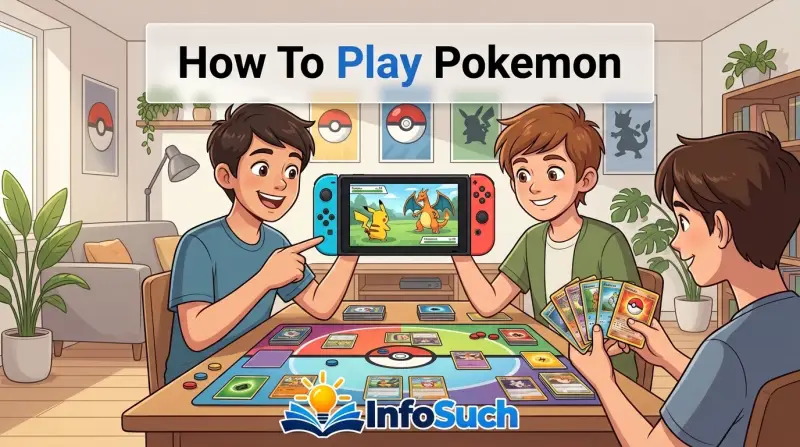
Whether you're picking up your first Poké Ball or coming back after twenty years, the question of how to play pokemon has more than one honest answer. You could mean the main video games, the trading card game, Pokémon GO, or one of the many spin-offs. They all share the same creatures, but the rules, goals, and daily loops are completely different.
The main series alone has sold over 480 million copies across nine generations as of 2026, making it the best-selling RPG franchise in history. With over 1,025 known species, 18 elemental types, and a competitive scene that spans both physical tournaments and online ladders, there's a version of Pokémon for nearly every kind of player. The trick is figuring out which one fits you, so let's walk through it.
Quick Answer
To play Pokémon, pick a format first. The core video games involve catching creatures, building a six-Pokémon team, and earning eight Gym Badges before challenging the Elite Four. The trading card game requires building a 60-card deck and taking six Prize Cards by knocking out opponents.
Pokémon GO uses real-world walking to catch creatures, battle in raids, and team up with local players. All three are official, supported, and worth your time. Choose based on your platform and whether you want to sit down or get outdoors.
Pick Your Pokémon First: Which "Play" Do You Mean?
Here's the thing nobody tells newcomers: there isn't one universal rulebook. If someone says "let's play Pokémon," they might mean sitting on a couch with a Nintendo Switch, laying down cards at a kitchen table, or walking around a park with their phone out. Each version has its own learning curve, its own etiquette, and its own way to win.
So before you memorize type charts or worry about IVs, decide which Pokémon world you're entering. Ask yourself three questions:
- Do you want a single-player story with strategy, exploration, and collecting? That's the main series video games.
- Do you prefer head-to-head competition with a physical or digital deck? That's the Pokémon Trading Card Game.
- Do you want something that gets you outside and connects with real-world locations? That's Pokémon GO.
There are spin-offs too, like Pokémon UNITE, Pokémon Mystery Dungeon, and the Pokkén fighting games. They're fun, but the three main pillars above are where 95 percent of players start.
If You Want the Classic RPG Experience
The main series games on Nintendo Switch are the default starting point for most people. They're turn-based, single-player adventures where you explore a region, catch wild Pokémon, train them in battles, and take on Gym Leaders to earn Badges. The latest entries, Pokémon Scarlet and Pokémon Violet, offer open-world exploration and a story that doesn't hold your hand as much as older titles.
These games are the closest to what most people picture when they hear "Pokémon." You build a team of six, learn type matchups, and slowly grow stronger through battles. They're forgiving for beginners but have enough depth for competitive training, breeding, and online play.
If You Want Tactical Head-to-Head Battles
The Trading Card Game is a different beast. Instead of controlling a trainer on a screen, you're building a 60-card deck and playing against one opponent. You draw cards, attach Energy, evolve Pokémon, and attack with the goal of taking all six Prize Cards.
It's faster than the video games, more interactive, and has a thriving tournament scene called Play! Pokémon.
The TCG has its own learning curve, but the rules are learnable in an afternoon. Deck building takes longer to master, which is why starting with preconstructed decks or the digital client, Pokémon TCG Live, is the smart move.
If You Want to Play Anywhere
Pokémon GO is the mobile version that exploded back in 2016 and still has millions of daily players. It uses your phone's GPS to place Pokémon in the real world. You physically walk to PokéStops, Gyms, and Raid battles.
Catching uses an augmented-reality interface where you flick Poké Balls at creatures in your surroundings.
The goal isn't gym badges in the traditional sense. It's completing Research Tasks, powering up a collection, and joining one of three teams: Valor (red), Mystic (blue), or Instinct (yellow). The grind is real, but the payoff is a hobby that gets you moving.
| Format | Core Goal | Best For | Time Commitment |
|---|---|---|---|
| Main Series | Earn 8 Badges, beat Elite Four | Solo RPG fans | 30-60 hours per playthrough |
| TCG | Take 6 Prize Cards | Competitive players | 20-30 min per match |
| GO | Catch, raid, level up | Outdoor walkers | 15 min to 2 hours daily |
How the Main Series Games Play (The Core RPG Experience)
The main series follows a formula that's been refined since 1996. You start in a small hometown, visit a professor who gives you a choice of three starter Pokémon (typically Grass, Fire, and Water types), and then set out to complete two goals: catch every Pokémon and become the region's Champion.
The core loop is deceptively simple. You travel through routes and towns, and wild Pokémon appear in tall grass, caves, or water. You battle them to weaken them, then throw Poké Balls to catch them.
Each catch and battle earns your team experience points, and once they level up enough, they evolve into stronger forms.
Understanding the Type Chart
Here's where strategy kicks in. Each Pokémon has one or two types, and there are 18 types in total: Normal, Fire, Water, Grass, Electric, Ice, Fighting, Poison, Ground, Flying, Psychic, Bug, Rock, Ghost, Dragon, Dark, Steel, and Fairy. Every type has strengths and weaknesses against other types.
The rule of thumb is simple: Fire beats Grass, Water beats Fire, Grass beats Water. But it gets deeper. Electric beats Water and Flying but does almost nothing to Ground types.
Dragon resists most types but is weak to Ice and Fairy. Fighting beats Normal, Ice, Rock, Dark, and Steel but is weak to Flying, Psychic, and Fairy.
A move that's super effective deals double damage. A move that's not very effective deals half damage. A move that's immune (like Ground against Electric) deals zero damage.
Most casual players memorize the common ones and check the rest online during battle.
How Catching Works
Catching a wild Pokémon isn't just about throwing a ball and hoping. The game calculates your catch rate based on the Pokémon's remaining HP, status conditions, and the type of Poké Ball you use.
Here's the practical sequence:
- Weaken the Pokémon with damaging moves but don't accidentally knock it out.
- Inflict a status condition if you can, like Sleep or Paralysis.
- Throw a Poké Ball. The odds improve if the ball is stronger (Great Ball, Ultra Ball) or special (Timer Ball, Dusk Ball).
The catch rate formula is hidden from players, but the visible feedback is the Poké Ball wobbling. Three wobbles and a click means you caught it. One wobble and a pop means it broke free.
It's luck, but good technique wins out over pure chance.
Progression: Badges, Gyms, and the League
Your main objective is to challenge eight Gym Leaders scattered across the region. Each Leader specializes in a type, and beating them earns you a Badge. Badges aren't just trophies; they raise your Pokémon's stats and let you control higher-level traded Pokémon.
After all eight Badges, you challenge the Elite Four, four back-to-back battles against skilled trainers. Win those and you face the Champion. Beat the Champion and you've officially completed the main story.
Modern games add a post-game arc, often involving legendary Pokémon or a rival storyline.
The Post-Game Opens Up
The credits roll, but the game doesn't end. Competitive players dive into ranked battles, breeding for perfect stats, and building tailored movesets. Casual players chase the Pokédex, hunting down the remaining species or shiny variants.
Tera Raids in Scarlet and Violet offer cooperative battles against powerful Pokémon with unique crystallization mechanics.
Whichever direction you go, the main series gives you a clear path to the end and then lets you design your own goals. That flexibility is a big part of why the franchise has lasted this long.
Building a Team That Doesn't Fall Apart
You can beat the base game with any six Pokémon you love. Players do it all the time with teams of favorites that are objectively weak in the competitive scene. But if you want a playthrough that flows smoothly without constant revives and expensive potions, your team needs balance.
Think of your team as a toolkit. Every battle is a problem, and your six slots are the tools you bring. If everything is a Water type and you hit a Grass Gym Leader, you're in trouble.
Spread your types so you always have an answer.
The Simple Team Formula
Here's a template that works for every generation:
- One Starter Pokémon (keep your original pick).
- One Flying type with a useful secondary type.
- One strong Special Attack user.
- One strong Physical Attack user.
- One bulky defender that can take hits.
- One flexible slot for a legendary, a rare catch, or a favorite.
This gives you coverage across types and roles. You'll have a glass cannon, a tank, a fast sweeper, and enough variety to handle most Gyms.
Why Type Overlap Hurts
If you pick a Fire starter, then add a Fire/Flying bird, then catch a Fire dog, you have three Pokémon that all lose to Rock and Water. Your team looks strong on paper until one opposing Pokémon sweeps it. Players make this mistake constantly.
For a casual run, just avoid stacking the same type twice unless you have a plan. If you love Electric types, make sure you have a Ground type on your team to absorb Electric attacks and hit back hard.
Physical vs. Special Moves
Each move is classified as physical (using the Attack and Defense stats) or special (using the Special Attack and Special Defense stats). Most physical moves are contact moves like Tackle, Bite, or Earthquake. Most special moves are energy attacks like Flamethrower, Thunderbolt, or Surf.
The rule of thumb: if your Pokémon has higher Attack, give it physical moves. If it has higher Special Attack, give it special moves. You can check these stats in the summary screen.
A mismatched move set, like a physical attacker with no physical moves, cuts your damage output dramatically.
EVs, IVs, Natures: The Hidden Numbers
Under the hood, every Pokémon has invisible values that determine its potential. Effort Values (EVs) come from battles won; each defeated Pokémon grants points in specific stats. Individual Values (IVs) are random numbers from hatch or catch that max out at 31 per stat.
Natures boost one stat by 10 percent and lower another.
Here's the honest truth: you don't need any of this for a normal playthrough. These systems only matter for competitive battling, where every stat point counts. For the story, just pick a decent nature and move on.
Worry about EV training when you start playing ranked.
Moveset Balance
Make sure your Pokémon carry variety. A water type with four Water moves hits hard but dies to a single Grass attack. Give it an Ice move to cover Grass and Dragon types, or a Dark move to hit Psychic types.
One coverage move per Pokémon is more valuable than a fourth STAB move.
The game tells you when a move is super effective with "It's super effective!" text. Use that feedback to learn matchups as you play. By the third Gym, you'll have the common ones memorized.
Going Deeper: Competitive, Challenges, and Older Games
Once you finish a playthrough, a whole different game opens up. Competitive Pokémon is practically a different sport from the casual story. It involves meticulous breeding, EV training, and team building around core concepts like weather teams, trick room strategies, or entry-hazard setups.
The official competitive format is called VGC, the Video Game Championships, governed by Play! Pokémon. Matches are double battles, meaning you bring four of your six Pokémon to fight at once.
The official rules change every season, with certain Pokémon banned and specific legendaries allowed. It's deep, complex, and genuinely rewarding to learn.
Nuzlocke and Challenge Runs
If you want more difficulty without going full competitive, the Nuzlocke challenge is the gold standard. The rules are community-made:
- You can only catch the first Pokémon you encounter in each area.
- Pokémon that faint are considered dead and must be released or boxed permanently.
- You must nickname every Pokémon you catch to build emotional attachment.
That simple house rule transforms the game into a high-stakes tactical survival. Losing a team member stings because they're gone for good. Many players say Nuzlocke runs taught them more about type matchups and risk management than any competitive guide.
Other popular challenges include the Monotype run (using only one type), the Solo run (one Pokémon against everything), and the Randomizer (which shuffles encounters and movesets).
Is It Worth Going Back to Older Games?
The older generations have their charm, but the modern games are the best place for newcomers. Pokémon Scarlet and Violet offer quality-of-life features that didn't exist in old games: visible wild Pokémon instead of random encounters, the ability to access the PC box from anywhere, and no HMs to teach your Pokémon for traversal.
Going back to the Game Boy Advance or Nintendo DS titles can feel clunky. The pacing is slower, grinding is more common, and the mechanics are simpler. But if you grew up with them, they're a nostalgia trip worth taking.
Just don't expect them to play like modern entries.
The Pokémon Trading Card Game in 10 Minutes
The Pokémon Trading Card Game has its own rhythm, and honestly, it's easier to learn than the video games once you see it in motion. A single match takes 15 to 30 minutes, and you can learn the core rules in one sitting.
Here's how a game works.
Setup
Each player has a 60-card deck, a basic Pokémon card, and a place for Prize Cards. You shuffle your deck, draw seven cards, and place six cards face-down as Prize Cards. Each player takes the top card of their deck and flips it; the winner of a coin flip decides who goes first.
You need at least one Basic Pokémon in your opening hand to start. If you don't, you reveal your hand, shuffle it back, and draw a new hand of seven. It's a mulligan, and your opponent gets to draw an extra card for each mulligan you take.
Turn Order
Each turn follows a strict sequence:
- Draw a card from your deck.
- Attach one Energy card from your hand to a Pokémon.
- Play Trainer cards (Items, Supporter, Stadium cards).
- Evolve a Pokémon (place a Stage 1 over a Basic, or Stage 2 over Stage 1).
- Retreat (pay a cost to switch your Active Pokémon to the Bench).
- Attack with your Active Pokémon.
That's it. The only limits are one Energy card per turn and one Supporter card per turn. Item and Stadium cards can be used without limit during your turn.
How You Win
You win by taking all six Prize Cards. You take a Prize Card each time your opponent's Pokémon is knocked out. If your opponent has no Pokémon left to bring to the Active Spot, you win immediately.
You can also win if your opponent's deck runs out of cards at the start of their turn.
The Deck-Building Rule
Each deck must have exactly 60 cards. You can only have four copies of any card with the same name, except basic Energy cards, which are unlimited. A good beginner deck has around 20 Pokémon, 15 Energy, and 25 Trainer cards, but that's a template, not a rule.
Different strategies require different ratios.
Where to Play and Learn
The best way to learn the TCG is to grab a preconstructed deck called a "League Battle Deck" or a "Theme Deck" and play a few games. The physical cards come with a rulebook, and Pokémon TCG Live, the digital client, walks you through matches step by step with visual prompts.
If you go to your local game store on a Pokémon League night, players are generally friendly and happy to teach. The community is older, more patient, and more focused on having a good game than winning a prize.
Common TCG Mistakes
Most beginners make the same errors, and they're easy to avoid:
- Playing too many Pokémon and not enough Energy.
- Forgetting you can only attach one Energy per turn.
- Using Trainer cards at the wrong time.
- Not understanding Bench space, which is five Pokémon max.
- Ignoring your win condition. Always know how close you are to taking those six Prize Cards.
The TCG is a skill game with a deck-building layer that takes time to master. But the barrier to entry is low, and the digital version means you can practice without spending money on physical cards.
What to Know if Pokémon GO Is More Your Speed
Pokémon GO flips everything about the main series on its head. Instead of sitting with a controller, you're walking, running, or biking through the real world. The game uses your phone's GPS to place Pokémon, PokéStops, and Gyms on a map that mirrors your actual surroundings.
The daily loop is simple: open the app, check what's nearby, spin PokéStops for items, and catch whatever appears. You'll also hatch Eggs by walking distance, complete Field Research tasks, and battle in Gyms or Raids. It's a completely different rhythm, but the underlying goal of collecting and powering up is the same.
The Three Teams and Why They Matter
At level 5, the game forces a choice: Team Valor (red), Team Mystic (blue), or Team Instinct (yellow). This decides who you fight with in Gyms and which allies you'll see in raids. If your friends already play, join their team so you can take down Gyms together.
If you're solo, pick based on which color looks best to you. The choice doesn't lock you out of any content, but switching later costs real money.
Stardust and Candy: Spend Wisely
These two resources are the backbone of progression in Pokémon GO. Candy is species-specific and comes from catching, transferring, and hatching. Stardust is universal and comes from just about everything.
Together, they power up and evolve your Pokémon.
The classic beginner mistake is dumping Stardust into the first strong-looking Pokémon you catch. It feels good in the moment, but you'll run out fast. Save Stardust for high-IV (high Individual Value) Pokémon with good movesets.
The in-game appraisal feature tells you how strong your Pokémon are. Wait until level 30 or 35 before spending heavily, since high-level wild spawns appear at those player levels.
Raids, Community Days, and Events
Raids are cooperative battles against powerful Pokémon, usually Legendaries. You join up to 20 players and fight in real time, tapping to attack and dodging charged moves. Winning a raid gives you a chance to catch the boss Pokémon with Premier Balls.
Community Day is a monthly event featuring one species with boosted spawns and a special move if you evolve it during the event hours. Raid Hours happen weekly, spotlighting a single raid boss for 60 minutes. These events are where you get the best Pokémon, but they're also where you spend the most resources.
Show up prepared with potions, revives, and Pinap Berries.
The GO Battle League
If you want competitive PvP in Pokémon GO, the GO Battle League is your arena. It's a separate ranked ladder where you bring three Pokémon and battle other players in real time. The format rotates between Great League, Ultra League, and Master League, each with different CP (Combat Power) caps.
PvP in GO is surprisingly deep. Moves have different durations and energy costs, switching has a cooldown, and shields are limited to two per match. If you're a main-series player used to turn-based combat, this is a fast, frantic change of pace.
It's free to play, and even casual players can earn rewards by participating.
Safety First
Because Pokémon GO is played outdoors, the safety rules matter more than in any other version. Never play while driving, even at a red light. Stay aware of your surroundings, especially near roads and bodies of water.
The game includes a "playing while driving" warning, and local parks and campuses are the safest places to play. Niantic's official guidelines emphasize situational awareness, and they're worth taking literally.
Common Mistakes Almost Every New Player Makes
We've watched enough fresh players hit the same walls across all three formats. These mistakes aren't a matter of intelligence. They're a matter of not knowing what the game expects of you.
Here's the short list of what trips everyone up.
Picking a Starter Based on Looks Alone
Everyone falls in love with the cute Fire fox or the tough Water crocodile. That's fine, but the smarter move is to look at the rest of your team before you commit. If you pick Fire, make sure you pick up a Water and a Grass type in the first few routes.
Coverage beats favorites when you're trying to win.
Skipping Status Conditions When Catching
In the main games, throwing balls at a full-health Pokémon is a rookie move. Paralysis, sleep, and freeze all boost your catch rate significantly. Even a simple Thunder Wave before the ball throw makes a difference.
In Pokémon GO, the equivalent is using Razz Berries and landing curveball throws. They stack with each other and increase your odds meaningfully.
Overloading a TCG Deck with Pokémon
A 60-card deck with 30 Pokémon in it is a losing hand. You need Energy to attack and Trainers to accelerate your strategy. Most successful builds run between 15 and 20 Pokémon.
If you're over 25, cut some and add draw Supporters like Professor's Research instead.
Burning Stardust on Pokémon You'll Outgrow
In Pokémon GO, you get roughly 3,000 to 5,000 Stardust per day from casual play. Powering a single Pokémon from level 20 to 40 costs over 200,000 Stardust. If you spend it early on a low-IV, low-level Pokémon, you've thrown away days of grinding.
Wait for high-tier species with good stats, then invest.
Ignoring Type Matchups and Wondering Why You Lose
Every format rewards type knowledge. A level 50 Charizard loses to a level 40 Squirtle if the Water type lands a super effective Hydro Pump. The game tells you when an attack is super effective.
Read that text, learn the pattern, and build your team around it.
Not Using the Box or Storage System
In the main games, you have access to a PC box with hundreds of slots. Use it. Don't walk around with a full party and no backup.
Swap in type advantages for each Gym battle. In Pokémon GO, storage is a premium resource, but it's still cheap enough to keep a few of each type for events and tasks.
Forgetting to Heal Between Battles
It sounds obvious, but players rush into the next fight with half their team fainted. The Pokémon Center heals your entire party for free in the main games. In GO, potions and revives are common drops from stops.
Use them before you see the "no usable Pokémon" screen and you'll save hours of backtracking.
How to Keep Playing Without Burning Out
Pokémon is a marathon, not a sprint. The franchise is nearly 30 years old, and millions of players have kept going for a decade or more. The secret isn't grinding harder.
It's figuring out which slice of the game actually brings you joy and letting the rest slide.
Set Your Own Goals
The game gives you a main quest, but your real goals are self-directed. Some players chase a complete Living Dex, meaning one of every species in storage. Others hunt shinies, which have roughly a 1 in 4,096 base encounter rate in the main games.
Competitive players aim for Master Ball rank in the Battle League. Pick one goal, chase it, and feel the win.
Don't Force Competitive Play
VGC and the GO Battle League have steep learning curves. They require breeding, EV training, and move set mastery that takes weeks to understand. If that doesn't pull you in, it's completely fine to stay in the single-player sandbox.
The games are designed to be finished by a 10-year-old, after all.
Use Playthrough Variations to Stay Fresh
When the same old route feels boring, start a new file with a self-imposed rule set. A Monotype run forces you to use only one type, which changes how you approach every Gym. A Nuzlocke run adds permanent death and scarcity.
A Randomizer shuffle reimagines the whole region. Each variation tests your strategic thinking without requiring an online subscription.
Balance Effort and Enjoyment
There's a school of thought that says every spare moment should go into catching, raiding, or battling. That leads to burnout within months. The healthier path is to treat Pokémon like any hobby: play when it's fun, set it down when it isn't.
The game will still be there tomorrow, and events repeat on a cycle.
Embrace the Community
Pokémon has one of the most welcoming communities in gaming. Local leagues for the TCG and GO meet weekly at game stores and parks. Discord and Reddit servers host trading, raid coordination, and strategy discussions.
Playing with other people turns a solitary grind into a social hobby.
Where to Find Current Rules and Events
Pokémon changes constantly. New generations arrive every few years, TCG sets rotate, and GO events shift with the calendar. Keeping track of what's current is half the battle, and the wrong sources lead you astray.
Official Sources Only
The Pokémon Company International runs the central hub at Pokemon.com. It hosts the official Pokédex, TCG rules, tournament schedules, and news for new releases. Nintendo's support site handles Switch-specific questions, from online play setup to trade connection errors.
For Pokémon GO specifically, the in-app news tab and the official Pokémon GO Live blog list Community Day schedules, raid bosses, and events weeks in advance. Niantic only announces features through official channels, so anything you see elsewhere should be treated as speculation.
Play! Pokémon for Tournaments
If you want to compete, Play! Pokémon is the governing body. It maintains the standard format rules for the TCG and VGC, publishes banned lists, and sanctions events from local leagues to World Championships.
The rulebook is updated each season. Always check the current rules before building a deck or team, since the legal card pool changes with each rotation.
Why You Should Skip Unofficial Wikis for Rules
Wikis are great for lore, move sets, and location guides. They're unreliable for competitive rules and event schedules. Community-run databases often lag behind official announcements, and they don't have the authority to clarify rule disputes.
For anything that affects a tournament or a purchase, go straight to the source.
TCG Card Rotation
The TCG rotates sets out of Standard format every year. Older cards move to the Expanded format, which has its own ban list. If you're building a tournament deck, check the current Standard rotation on the official site.
You'll avoid buying cards you can't play.
Events Calendar Basics
The main games don't have a consistent event calendar the way GO does. Mystery Gifts are distributed through the internet and often tie into Pokémon Day in late February or new movie releases. TCG expansions drop roughly every three months, with new card sets pushing the competitive meta forward.
| Format | Official Source | What to Look For |
|---|---|---|
| Main Games | Pokemon.com, Nintendo Support | New game announcements, Mystery Gifts |
| TCG | Pokemon.com, Play! Pokémon | Card rotation, tournament formats |
| Pokémon GO | In-app News, Pokémon GO Live blog | Community Days, raid bosses, events |
Frequently Asked Questions
Can I play every Pokémon on one console?
Not currently. The main series games on Nintendo Switch cover the most recent generations, but older games from the Game Boy, DS, and 3DS era aren't available on modern hardware without trading, hacking, or repurchasing. Pokémon HOME lets you store and transfer many species into the latest games, but not all of the 1,025 are catchable in any single title.
Do I need to know the type chart by heart to be good?
No, but it helps. The games tell you when a move is super effective or not very effective, and the TCG cards list weaknesses directly. Casual playthroughs only require remembering the common pairings: Fire beats Grass, Water beats Fire, and so on.
Competitive players memorize the full chart, but you can start with ten pairs and build from there.
Is the TCG worth getting into if I already play the games?
Yes, for a different reason. The card game is faster, more interactive, and easier to play with friends in person. It also has a lower barrier to entry for competitive play, since anyone can buy a preconstructed deck and enter a local tournament.
The digital client, Pokémon TCG Live, even gives away free decks to start.
How long does a full playthrough actually take?
A standard Pokémon Scarlet or Violet run takes 30 to 40 hours to see the credits. That includes catching, Gym battles, and the main story. Players who skip optional content and use strong team builds can finish in under 25 hours.
Completionists who chase every Pokémon, side quest, and post-game activity can easily spend 100 hours or more.
What's the cheapest way to start?
For the main games, a used copy of a prior generation title on the Switch is the lowest upfront cost. For the TCG, Pokémon TCG Live is completely free and includes starter decks. Pokémon GO costs nothing to play, though in-app purchases speed up progression.
The subscription cost of a Nintendo Switch Online membership, around $20 per year, is only required for online trading and battling in the main games.
Can I play Pokémon competitively without spending real money?
In all three formats, competitive play is possible as a free-to-play player. The TCG gives away product codes in physical packs and through TCG Live. VGC players can breed and train using in-game mechanics alone.
Pokémon GO's Battle League has free tiers with rewards. The gap between free and paid players exists but is smaller than in most games.
What is the best Pokémon for a beginner team?
There isn't one. A balanced team of six, covering at least four types, is more effective than any single overpowered species. If you want a strong early pick, look for a Pokémon that evolves early and has good type coverage, like the starting bird in most generations or any line that learns both Physical and Special moves.
The Bottom Line: Your First Move, Based on You
You've now seen the full landscape. Three main formats, each with its own rules, its own pacing, and its own community. So which one do you actually start with?
The answer depends on three things: your platform, your schedule, and your competitive appetite.
Let's break it down by player type.
If You Want the Classic RPG Experience
Start with a main series game on Nintendo Switch. The best entry point for newcomers in 2026 is Pokémon Scarlet or Pokémon Violet. They have open-world exploration, a gentler difficulty curve, and all the current mechanics that tournaments use.
Your first move: pick the starter that looks fun, play through the first few routes, and don't worry about EVs or IVs until you've beaten the Elite Four. That playthrough will teach you type matchups, catching, and team building organically. When you're ready, the post-game Tera Raids and online Battle Stadium offer the next step.
If You Want Tactical Head-to-Head Battles
Download Pokémon TCG Live first. It's free, it runs on PC and mobile, and the tutorial forces you to learn the actual turn structure. Play through the beginner missions, redeem the starter decks, and you'll be ready for a physical League Battle Deck if you want to play in person.
Your first move: build a simple deck with one evolution line, 15 Energy, and plenty of draw Supporters. Then go to a local game store on a Pokémon League night and ask for a practice match. The TCG community loves teaching newcomers.
If You Want to Play Anywhere
Pokémon GO is the only format that gets you outside. If you already walk for exercise or commute on foot, this is the natural fit. Start by downloading the app, catching whatever appears, and spinning PokéStops.
Join the team your friends are on, and attend a Community Day within your first month to see how events change the game.
Your first move: don't spend any Stardust until level 30. Just catch, hatch, and complete Research Tasks. By the time you hit that level, you'll have plenty of strong spawns worth investing in.
A Simple Decision Table
| If You Want… | Start With… | Time Investment | Cost to Start |
|---|---|---|---|
| A solo story adventure | Pokémon Scarlet/Violet on Switch | 30-40 hours | $60 + console |
| Fast competitive matches | Pokémon TCG Live | 15-30 min per game | Free |
| Outdoor activity and social play | Pokémon GO | 15-60 min daily | Free |
| A mix of solo and competitive | Main games, then VGC ranked | 50+ hours total | $60 + online subscription |
One Final Piece of Advice
Don't let anyone tell you there's a wrong way to play Pokémon. The guy with 400 hours in the Battle League and the kid playing Pokémon GO on the way to school are both getting the real experience. Pick the format that fits your life today, learn it properly, and branch out when you're curious.
Every format shares one thing: a world that rewards patience, curiosity, and a little bit of strategy. That's what's kept it going for three decades.